BiteGeist · 1001 Stories
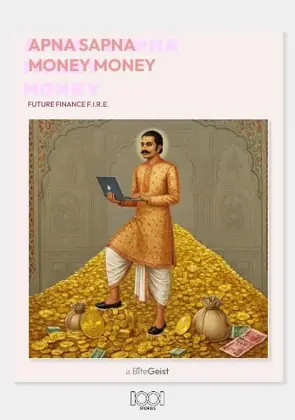
Apna Sapna Money Money
Less F.I.R.E. More A.A.A.G.
By Utkarsh Singh, Prakash Sharma, Reshma Tonse
Read the full report on 1001 Stories ↗A BiteGeist by 1001 Stories on how Indians save, spend and plan for the future, and why the F.I.R.E. (Financial Independence, Retire Early) dream does not fit most of India.
India has long been a savings-driven economy. Yet net financial savings of Indian households almost halved, from 10% of GDP in FY11 to 5.4% in FY23. UPI and EMIs have reduced the pain of paying, and spending on small indulgences has risen while essentials are held back.
The report argues that most earning Indians are not chasing F.I.R.E. Their desire is better summed up as A.A.A.G.: Aspire, Arrive, Age Gracefully.
Concepts in this report
Core concept
A.A.A.G. (Aspire, Arrive, Age Gracefully)
The financial desire of the larger Indian populace, in place of F.I.R.E. Financial advisors and the top 3% can automate investing large chunks of income and swear by F.I.R.E. The larger masses, once taken by the idea, are losing optimism around it and are looking for options they can call realistic. Their desire can be summed up as A.A.A.G.: Less F.I.R.E. More A.A.A.G.
A.A.A.G.
Arrive
Fired up by F.I.R.E., earning professionals aim for financial independence. The math does not add up, but what they have managed to create is a healthy financial fitness habit. For a large BFSI consumer base, the ability to invest, diversify income and be future-prepared feels like arriving in life. Aspirations must be met, but not early. There is no hurry.
“After MBA, almost half my batch bought a home, or got married, or got a small plot of land and everything came from a parent. Then, you have a kid. So you are locked in... People are saying, 'Why get married early? Why have kids early?' It's still a small thing, but the voices are getting louder.”
A.A.A.G.
Aspire: meaning from work > money
In India, work is associated with status and community, not only money. Career and work experience are social capital, so after leaving the workforce Indians see themselves as continuing to build it. Giving up on building social capital means aging. Where retirement once meant living on a predetermined corpus, retirement today must entail the continuation of a revenue stream: consulting, freelancing, rental property or agri-businesses.
A.A.A.G.
Age gracefully: age-agnostic youth
In the new work identity there is no getting 'older', only an expanding youth canvas. For the new Indian consumer, the late phase of life is not about becoming free of responsibility and stopping work, but about finding new potential and becoming socially more relevant. For the new Indian, retirement is a backup growth opportunity.
“Retirement is for people who cannot grow in life. Ab bas, ab baith jao.”
Concept
Indians do not have piggy banks
The Western piggy bank is conceptually about saving for a purpose. The Indian Gullak, Chukka or Undiyal is about saving until an emergency arises, which, by God's grace, will hopefully never happen. Breaking a piggy bank is exciting; a broken Gullak is discomforting. Nothing was saved to spend. Any expenditure was an 'emergency'.
Concept
One way to feel rich is to save money. Another is to spend it.
UPI and EMI payments drastically reduce the pain of paying, leading to reduced savings and increased expenditure in the Indian household. 74.2% of respondents in an IIIT Delhi survey reported increased spending after adopting UPI. Ezetap reported a 220% increase in EMI transaction volumes post-pandemic, and earning individuals in India spend over 33% of their monthly salary on EMIs.
Concept
Changing contexts, changing behaviour
The context of saving instruction was scarcity and uncertainty. It produced beliefs of loss aversion, need for stability and 'low risk' as a virtue, and the behaviour of saving long term in risk-free instruments. The context of wealth creation instruction is surplus and frictionless upgrades of lifestyle. It produces the belief that one should be curious and try riskier instruments in small amounts, and the behaviour of hunting for short-term returns while explaining losses as the long-term nature of instruments. The aam aadmi is looking to answer an old context with a new behaviour, but is open to being introduced to new desires and new behaviour.
Concept
True F.I.R.E. is for the top 3%
F.I.R.E. has morphed into many forms in India: Fat, Lean, Chubby, Coast and Barista F.I.R.E. Indian aspirants are realising that the people who can and will achieve F.I.R.E. are those who were going to retire in their 50s anyway: product managers with large paychecks, generational wealth holders, business owners and founders who will sell, and property owners whose assets already generate passive income.
Concept
Five context shifts of the Indian consumer
Across deep-contextual studies in FMCG, automotive, public health, ed-tech, e-commerce, q-commerce, BFSI, fashion, luxury and technology, 1001 Stories observed five shifts shaping how Indians plan for the future: (1) new aspirations and signals different from the collective's; (2) changing gender roles affecting financial choices; (3) intra- and inter-city access, migration and a new-found Indian individuality; (4) new codes of youth and self, and new metrics of success; (5) an expectation of evergreen, age-agnostic youth that changes future goals.
Framework
The Time-Money Mosaic
In categories that marry present and future selves, four co-existing and opposite forces act on one another: Culture & Beliefs, Current Trends, Fears, and Desires. Each exerts and counteracts on the others, moulding current beliefs and actions. For any new product to work, it must consider these contradictions and find its place alongside these tensions.
This page is a summary. The concepts above are from Apna Sapna Money Money, a BiteGeist by 1001 Stories. Page numbers refer to the report PDF. The full report, with its data, illustrations and sources, is published by 1001 Stories.
Read the full report on 1001 Stories ↗