Jan 2025
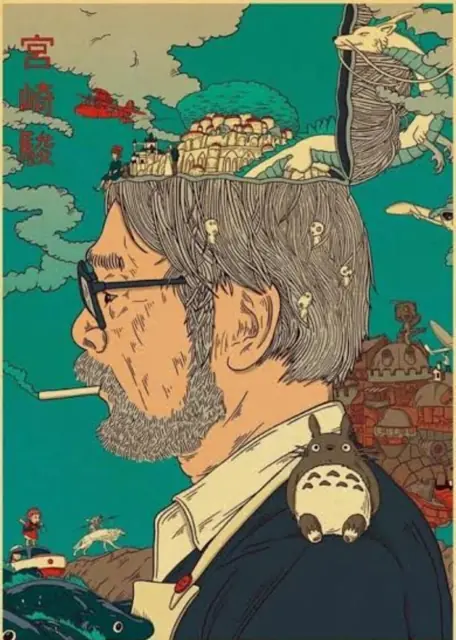
The Miyazaki's Curse
Miyazaki's Curse.
Our primal desires as groups and cultures often influence our individual lens of processing reality, the objects/people in it, and our relationship with them.
One can have love for Krishna the way Meera did, or one can submit to Allah without needing a "form", or follow Ram as the model man.
One can collect wisdom through gurus who first drove social change, and then became warriors- and consider the book itself a living entity or one can be devoted to a person who bore the burden of humanity's sins.
It changes our language. It changes our mind. It changes our eyes. It changes how receptive we are to seeing what we have never seen.
Miyazaki wanted to point out how flawed our anthropocentric view of the world is through his messages about war and environmentalism.
Difficult emotions turned, unfamiliar points of view, twisted- and no change was achieved.
Other than a nostalgic feeling of magical fantasy- and a reminder of childhood.
Environmental nostalgia if you may.
Only the common myths survive transition.
Eden, the flood, the thunder gods and the judgement day.
And the lives, stories and characters in between - get lost in their uniqueness.
The world shall only see and hear you through the language of the myths it already knows.
It can't watch. It can't listen.
It does what it does to survive.
So when you're challenging ideas, myths, language and culture.
You're challenging survival.
As beautiful as your challenge may be.
As important, as your challenge may be.
The real challenge always is making it appeal to the existing idea of survival.
That is the only way one myth, wins over another.
Miyazaki's Curse is not merely "loss in translation" as a linguist or language enthusiast would describe it.
Miyazaki's curse extends beyond.
It is the inability of a point of view to be understood as is, for the lack of a common code of survival, Object-Subject relationship, and meaning system together.
It is not a loss in translation. It is morphed in translation.