May 2024
How Intuition works in solving human centric problems
Academia does not teach you how to use your intuition.
The reason you go into academia, is also not because you were seeking to develop your intuition, rather, to find ways through which you can always come up with results that show p <.01.
Everyone working with human behaviour who slaps the term "science" to feel a sense of legitimacy needs to understand how science itself has evolved from the Newtonian to the relativistic, to the quantum era.
How it has evolved from trying to reduce everything down to simple variables to trying to understand the nature of emergent systems.
I was recently having a discussion with a LinkedIn connection about how, when we take up any project, there is an entire universe of variables and behaviours to capture so a single usable insight can be derived.
The follow-up question was -
"How do you make this call, especially when so many factors could be dependent on intuition, and there is a need for accountability to other stakeholders or project owners?"
Very valid. Here are my thoughts on it -
1. How is intuition a form of intelligence that cannot be accounted for? Are professionals paid for their methodical rigour - which can be learnt by anyone- or are they paid for being right more times?
From an educational perspective, the process of developing intuition is critical.
Klein (2003) construed intuition to be superior in relation to knowledge because he proclaimed that intuition is “built up through repeated experiences, unconsciously linked together to a form of pattern” (p. 11).
The more patterns are available, the easier a sense of familiarity arises in challenging situations and, thus, the more opportunities exist for an intuitive decision.
2. Any data, ever, is always interpreted with a set of hypotheses which-
a. Relies on a theoretical construct
b. Is dependent on a paradigm
c. Is selected based on its explanatory power
Though the parameters of how that selection is done will always have intuition playing a role- whether one accepts it or not is a different story.
No research comes without biases; some biases work better. Being aware of them is critical.
3. All work is optimised towards solving a problem- if the variable in question is a variable which is indeed important, but not actionable in the context of the problem, you know what must be focused upon.
It doesn't mean one reduces the scope of what they see, but one doesn't come to you simply for the sake of knowledge.
4. "All models are approximations; some models are useful".
The problem arises when the model itself becomes your lens for looking at the world. You start seeing less, and fitting pegs in a hole more.
That is antithetical to science.
The core of science is curiosity, discovery and sense-making- the ability to make predictions is a byproduct.
Right now, it feels driven by a need for certainty.
Improving knives would've never created a gun.
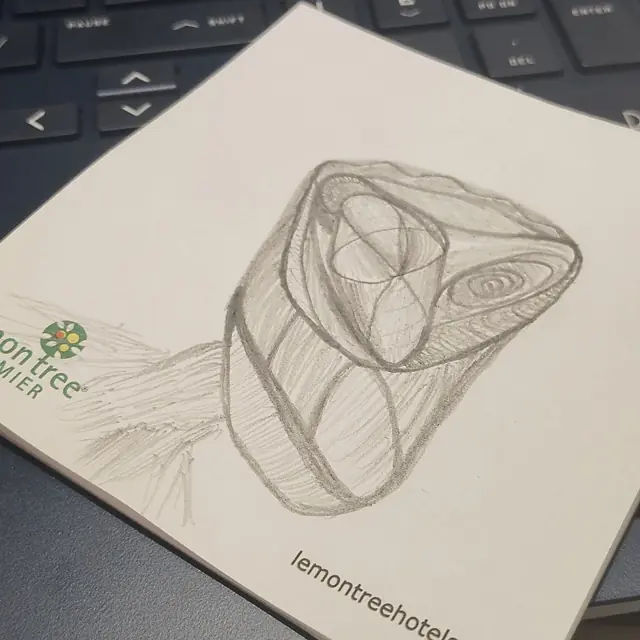
The picture above is a representation of how I feel going into each project. Repeating again: Intuition is not guesswork. It is sharpened pattern recognition through repeated exposure to complex problems.